S4E10: The Week London Couldn’t Breathe

 Apple Podcasts
 Spotify
 Youtube Music
 In this episode of Sustainability Forward, we introduce a new type of content: a story-led sustainability deep dive.
Instead of our usual conversation format, we step back into one defining moment in environmental history: the Great Smog of London.
For five days in December 1952, London was trapped under a thick, toxic blanket of coal smoke and fog. Streets disappeared. Transport stopped. Hospitals filled. Thousands of people died. And eventually, the disaster helped force a political and social reckoning that led to the UK’s Clean Air Act.
But this is not just a story about air pollution in the past.
It is a story about what happens when environmental harm becomes normalised. It is about systems that appear to work until their hidden costs become impossible to ignore. And it is about the role of policy, public pressure and leadership in changing what society is willing to tolerate.
As cities, companies and governments today confront climate change, air pollution, water stress, biodiversity loss and other sustainability challenges, the Great Smog offers a powerful reminder: sustainability failures rarely arrive out of nowhere. They build slowly, often in plain sight.
This episode asks a simple but urgent question: what are we breathing in today without noticing?
Hello, and welcome to Sustainability Forward.
Usually on this podcast, Carmine and I are in conversation — with each other, with guests, with people working across business, policy, energy, finance, and sustainability.
But every now and then, we want to do something a little different.
We want to step away from the interview format and tell one story.
A story from the past.
A story about a moment when sustainability was not a strategy document, or a corporate target, or a regulation waiting to be implemented.
It was something much more immediate.
It was in the air people breathed.
It was in the streets they walked through.
It was in hospitals, in homes, in offices, in lungs.
And today’s story is one of the most powerful environmental stories in modern British history.
It is the story of the Great Smog of London.
Or, put another way, the week London couldn’t breathe.
On the morning of Friday, the 5th of December 1952, London woke up cold.
That, by itself, was not unusual.
This was post-war Britain. A city still recovering from the trauma of the Second World War. A city of bombsites, rationing, coal fires, industrial chimneys, crowded homes, and a population accustomed to hardship.
Londoners knew winter.
They also knew fog.
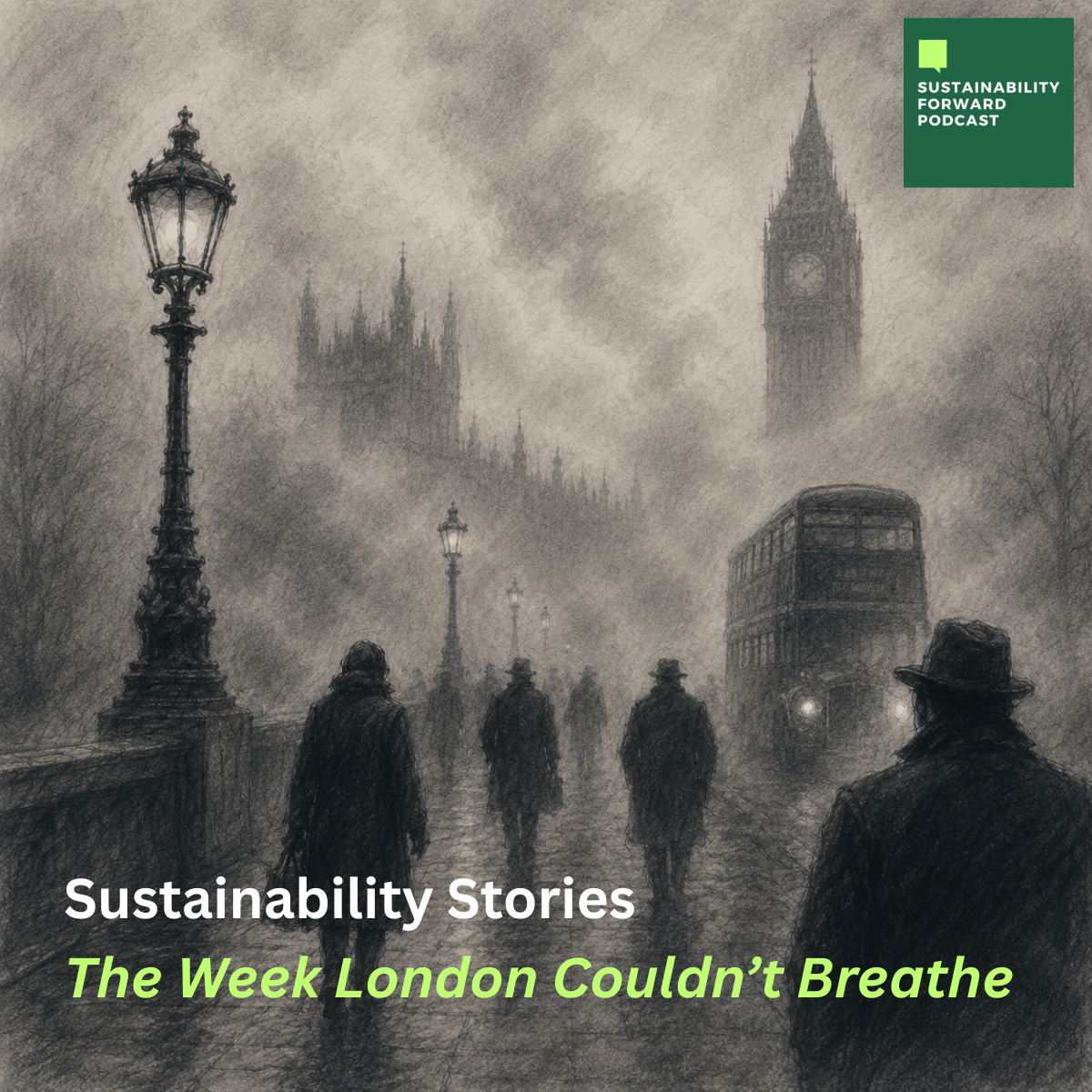
For generations, London had been famous — almost romantically famous — for its fog. The city’s “pea-soupers” had become part of its mythology: thick, yellow-brown fogs that rolled through the streets, swallowed buildings, softened the gas lamps, and turned the city into something mysterious and almost theatrical.
Writers had used it. Painters had captured it. Tourists imagined it.
Fog was part of London’s identity.
But this was not ordinary fog.
And within a few hours, Londoners began to understand that something was different.
The air did not simply look misty.
It looked dirty.
It had weight.
It had colour.
It crept indoors.
It came through cracks in doors and windows. It entered cinemas and theatres. It entered offices and bedrooms. It settled into people’s clothes, their curtains, their throats.
Visibility dropped so dramatically that in some places people could barely see a few feet ahead of them. Buses stopped running. Cars were abandoned. Ambulances struggled to reach patients. People walking home had to feel their way along walls and railings.
There are stories of people getting lost in their own neighbourhoods.
Stories of parents trying to find children.
Stories of conductors walking in front of buses with torches before even that became impossible.
This was not weather anymore.
This was a city shutting down.
To understand what happened, we have to understand the London of 1952.
This was a city powered by coal.
Coal heated homes. Coal powered factories. Coal generated electricity. Coal was embedded into daily life, into the economy, into the rhythms of the city.
In the early 1950s, many London homes still burned coal for warmth. And because it was bitterly cold that December, households burned more of it.
But the coal available for domestic use was often poor quality. Britain was exporting much of its better coal for economic reasons, and at home people were often left burning coal that produced more smoke and sulphur.
At the same time, London’s power stations and factories were also releasing smoke into the air.
On another day, some of that pollution might have dispersed.
But on this particular weekend, the weather trapped it.
A high-pressure system settled over London. The air became still. There was very little wind. A temperature inversion formed — a layer of warmer air above colder air near the ground. And that colder air, full of coal smoke, soot, sulphur dioxide and other pollutants, had nowhere to go.
So it stayed.
And every hour, more smoke was added.
More homes lit their fires.
More chimneys released soot.
More pollution accumulated under the invisible lid above the city.
The fog became smog — smoke and fog together.
A familiar London inconvenience became a public health disaster.
One of the most haunting things about the Great Smog is that, at first, many people did not fully understand the scale of what was happening.
There was no rolling television coverage.
No live data dashboard.
No air quality app telling people to stay indoors.
No social media videos showing the city disappearing into yellow darkness.
People experienced it individually, locally, physically.
A bus route stops.
A theatre performance is cancelled because the audience cannot see the stage.
A football match is abandoned.
A mother notices her child coughing.
An elderly man struggles to breathe.
A doctor receives more calls than usual.
A hospital ward fills.
And then the pattern becomes impossible to ignore.
People with existing respiratory conditions were hit first. The elderly. The very young. Those with bronchitis, asthma, heart disease. People whose bodies had less margin left.
But the smog did not politely limit itself to the vulnerable.
It affected workers, commuters, families, animals, entire neighbourhoods.
Cattle at a major livestock show reportedly died.
Hospitals became overwhelmed.
Undertakers ran short of coffins.
And still, outside, the air remained thick.
For five days, from the 5th to the 9th of December, London was trapped inside its own emissions.
Then, finally, the weather changed.
The wind returned.
The smog lifted.
And London began to see itself again.
But by then, thousands were dead.
At the time, the official estimate was around 4,000 deaths. Later research suggests the real toll may have been far higher — perhaps around 12,000 lives.
Thousands more suffered respiratory illness.
And this is where the story changes.
Because the Great Smog was not just an environmental disaster.
It was a moment of recognition.
A moment when something that had been accepted for decades — smoky air, dirty air, industrial air — became morally and politically impossible to ignore.
Before the Great Smog, air pollution in London was not new.
That is important.
This was not a sudden problem.
It was an old problem that had become normal.
For decades, London had lived with smoke. It had been treated as the price of warmth, the price of industry, the price of economic life.
Yes, people complained.
Yes, reformers warned about it.
Yes, doctors understood that dirty air damaged health.
But the city had learned to live with it.
And this, to me, is one of the most important lessons from the story.
Many sustainability problems do not begin as crises.
They begin as compromises.
A little smoke.
A little pollution.
A little waste.
A little risk.
A little damage shifted onto someone else, somewhere else, or some future generation.
And because the system still functions, because business continues, because people adapt, the compromise becomes normal.
Until one day, the conditions change.
The wind stops.
The weather turns.
The hidden cost becomes visible.
And what looked manageable becomes catastrophic.
The Great Smog was not caused by one chimney, one household, one factory, or one decision.
It was caused by a system.
A system of energy, housing, poverty, industry, infrastructure, weather, and policy delay.
And that is why it is such a powerful sustainability story.
Because sustainability is often about systems that appear to work — until they don’t.
After the smog lifted, the political response was not instant.
That is another important part of the story.
Today, when we look back, the lesson seems obvious: deadly air pollution led to clean air legislation.
But history is rarely that neat.
At first, there was hesitation.
There were questions about whether pollution had really caused the deaths. There were concerns about cost. There were questions about practicality. There were entrenched habits and economic interests.
Changing the way a city heats itself is not easy.
Changing fuels is not easy.
Changing industry is not easy.
Asking households to move away from familiar energy sources is not easy.
In that sense, the debate after the Great Smog has echoes of many sustainability debates today.
Who pays?
How fast can we move?
What is the role of government?
What is the role of industry?
What happens to poorer households?
What happens when the science is clear, but the politics is slow?
But the scale of the disaster created a pressure that could not be ignored forever.
In 1956, four years after the Great Smog, the UK passed the Clean Air Act.
It introduced smoke control areas. It restricted the burning of dirty coal in urban areas. It pushed households and industry toward cleaner fuels. It helped begin a long transition away from the smoky city that London had once accepted as normal.
The problem did not disappear overnight.
There were further smog events. Further legislation followed. Implementation took time. Infrastructure had to change. Homes had to change. Energy systems had to change.
But the direction had shifted.
Clean air had become a public responsibility.
Dirty air was no longer just an unfortunate by-product of modern life.
It was a policy failure.
It was a health issue.
It was an environmental issue.
It was a social issue.
And ultimately, it was a leadership issue.
There is something deeply human about this story.
Because the Great Smog was not an abstract environmental event.
It was a lived experience.
Imagine being a child in London that week.
The world outside your window turns yellow and black.
The familiar street disappears.
Adults sound worried.
Your chest feels tight.
You hear coughing in the house.
You cannot see the end of the road.
And no one can tell you exactly when it will end.
Or imagine being a doctor.
The calls keep coming.
Breathing difficulties.
Chest pain.
Elderly patients deteriorating.
Hospitals filling.
You know the air is hurting people, but you cannot prescribe clean air.
Or imagine being a policymaker after the event.
The numbers arrive.
The deaths rise.
The evidence hardens.
And suddenly, the familiar defence — “this is how things have always been” — no longer works.
That is the emotional force of the Great Smog.
It made the invisible visible.
It made pollution personal.
It turned air — something people rarely think about unless it is missing — into a political fact.
So why tell this story now?
After all, London in 2026 is not London in 1952.
The coal fires are mostly gone.
The power stations have moved.
The yellow fogs no longer define the city.
In many ways, the Great Smog belongs to another era.
But the deeper story is still with us.
Air pollution remains one of the world’s major public health challenges. Cities across the world still struggle with particulate matter, nitrogen dioxide, ozone, industrial pollution, vehicle emissions, and unequal exposure.
And beyond air pollution, the pattern repeats across sustainability.
Climate change.
Water stress.
Biodiversity loss.
Plastic pollution.
Chemical contamination.
The details differ, but the structure is familiar.
A system creates value.
The damage is dispersed.
The costs are delayed.
The science accumulates.
The warnings grow louder.
Action is debated.
And then, sometimes, a crisis breaks through the noise.
The Great Smog reminds us that sustainability failures are rarely just technical failures.
They are failures of imagination.
Failures to see the system as a whole.
Failures to act before the harm becomes undeniable.
Failures to protect people who do not have the power to remove themselves from risk.
And that is why this story matters for business leaders too.
Because many companies today are operating in systems where externalities are becoming visible.
Carbon is becoming visible.
Methane is becoming visible.
Nature impacts are becoming visible.
Supply chain labour conditions are becoming visible.
Water risks are becoming visible.
Community impacts are becoming visible.
What was once hidden in the background is moving into the foreground.
And when that happens, the question for leaders changes.
It is no longer simply: are we compliant?
It becomes: are we contributing to a risk that society will eventually refuse to tolerate?
That is a much harder question.
But it is also a much more important one.
There are three lessons I take from the Great Smog.
The first is that normal is not the same as acceptable.
For decades, smoky air was normal in London.
People complained about it, joked about it, wrote about it, adapted to it.
But the fact that something is familiar does not mean it is safe.
And the fact that a system has operated for a long time does not mean it can continue indefinitely.
The second lesson is that environmental problems become political when they become personal.
Data matters. Science matters. Reports matter.
But change often accelerates when people can feel the issue in their own lives — when the cost is no longer abstract.
The tragedy of the Great Smog is that it took thousands of deaths to create that recognition.
The challenge today is whether we can act before the equivalent moments arrive.
The third lesson is that policy can change markets.
The Clean Air Act did not simply express concern.
It changed the rules.
It changed what fuels could be burned.
It changed what was acceptable in urban areas.
It helped shift investment, infrastructure and behaviour.
That is worth remembering today, when we sometimes speak about sustainability as if it is only about voluntary action, consumer preference, or corporate goodwill.
Markets matter.
Innovation matters.
Corporate leadership matters.
But rules matter too.
And sometimes, the role of policy is to say: the old way of creating value has become too costly for society to bear.
The story of the Great Smog is not a simple story of progress.
It is not a comforting story in which leaders saw the danger early and acted just in time.
They did not.
It is a story of delay.
Of normalised harm.
Of a city that had learned to live with dirty air until the air turned deadly.
But it is also a story of change.
Because eventually, the lesson was learned.
The law changed.
The energy system changed.
The city changed.
And London’s air, while still imperfect, is no longer what it was in December 1952.
That matters.
Because in sustainability, we often spend a lot of time talking about how difficult change is.
And it is difficult.
But the Great Smog reminds us that systems can change.
Cities can change.
Public expectations can change.
Things that once seemed normal can become unacceptable.
And things that once seemed impossible can become obvious in hindsight.
So, as we think about the sustainability challenges of our own time, maybe the question is not only: what is the next Great Smog?
Maybe the better question is: what are we currently breathing in without noticing?
What risks have we normalised?
What costs are hidden in our systems?
What warnings are we treating as background noise?
And what would it take to act before the air becomes unbreathable?
This has been Sustainability Forward.
If you found this story useful, please follow or subscribe wherever you listen to podcasts, share it with someone who might enjoy it, and connect with us on LinkedIn at Sustainability Forward – The Podcast.
You can also find us at www.sustainabilityforward.com.
Until next time, thank you for listening — and for helping move the conversation forward.