S4E4: Growing Food Where Community Happens


 Apple Podcasts

 Spotify

 Youtube Music

 Amazon Music

 PocketCasts

 Castbox
What if the modern version of a UK allotment isn’t a patch of land—but a classroom?
In this episode of Sustainability Forward, we speak with Alex Tyink, co-founder and CEO of Fork Farms, whose unlikely journey from opera singer to urban farmer began on a rooftop in Brooklyn—and turned into a mission focused on food access with dignity.
We explore why food is one of the most practical entry points into sustainability: it’s daily, personal, and deeply connected to health, community, and resilience. Alex explains why Fork Farms focuses on enabling others to grow (rather than operating farms themselves), why highly perishable foods like leafy greens matter most, and what changes when students grow food that ends up on the school lunch line.
We also get into the real-world side of scaling: what breaks in deployments, how you design for people who have never grown anything, and where AI can genuinely help day-to-day operators without becoming hype.
In this conversation:
-
Alex’s Brooklyn rooftop turning point—and how growing food reshaped purpose and wellbeing
-
Food access beyond price and calories: dignity, trust, and control
-
Why schools are the best place to start—and what happens when kids eat what they grow
-
Scaling distributed indoor growing without the “giant vertical farm” trap
-
Where automation and AI can improve consistency and operational confidence
If you’re looking for sustainability that feels human, practical, and achievable, this episode is for you.
0:08 Hello and welcome to Sustainability Forward. This is your host Rishi. With me, as always, is my Co host Carmine. How are you, Carmine? Good, Richie, welcome back. Welcome back Carmine. You may remember when we moved to the UK, which is around more or less similar timeline, or at least I found out something really unique about the UK, which is this idea of what is called allotments, which is essentially small patches of land, sometimes behind houses, sometimes along railway lines, sometimes in the corner of cities, including in London, where ordinary people, members of the public just grow food.
0:57 And that that never has been for influencers. It's just a regular thing that people do as part of normal life. And that habit encourages a little bit of, you know, community activity. It I think brings a little bit of resilience in the community. And honestly, people take a lot of pride in growing, you know, the odd carrot, you know, maybe a little bit of turnip or whatever, whatever the the British weather will permit. And so it made me wonder if allotments are kind of an answer to to the problem of, you know, people in big cities not knowing where their food is coming from. And in this sort of modern day version of of allotments, I think we could think about, you know, creating a mechanism to grow food more sustainably in, in in cities, right? And that could be in a school, it could be, you know, on top of a shopping mall or whatever.
2:02 And I think that's the conversation that we are bringing, bringing to sustainability for today, not futuristic agriculture for the sake of it, but you know, food access with dignity. And, and we are going to talk a little bit about what happens when growing food becomes something people can do where they already are instead of driving miles out, you know, to even see an agricultural farm. So Carmen, to do that, would you please introduce our guest for today's episode? Yes, Richie and by the way, a lot of memories from London as well. You you just mentioned, but today we are we're coming.
2:46 Alex Teink, the Co founder, CEO of four farms and inventor of his indoor farming technology and methods. Alex is a former opera singer who became his urban active character journey in Brooklyn, starting with rooftop rooftop gardens and then building indoor growing systems for education and food security. After moving back to Wisconsin, he held leadership roles across the social service sector including Goodwill Industries and Phoenix American Eastern Wisconsin, and he has been recognized locally for innovation and impact. Alex live in Appleton, WI with his wife, son and their dog Maya.
3:29 So, Alex, welcome to the show. Thank you very much for having me. Alex I In preparation for this, for this episode, we, we had a brief discussion a couple of weeks ago and, and you shared a little bit of your experience of the rooftop farming in Brooklyn. Maybe to start with, I want to take you back to the time if you could help us understand what was going on in your life and and what shifted once you started, you know, growing food on on that rooftop.
4:11 Yeah, of course. And your listeners might be wondering what business does an opera singer have getting into growing food and, and feeding people. And yeah, I will, I will tell you that I've come to learn that it's more, more connected, I think, than some people might realize. For me, I moved to New York City to pursue this passion for music. And I originally got into music because of the discipline it requires and the historical context and being able to share with other people and to bring joy, frankly.
4:53 And when I got to the city, I think I was met with a very different environment both in the city and in the industry than I expected. And I did fine. You know, I, I, I sang for some opera companies and I, I did some commercials and all sorts of things. And I, and I really got to get a view into the entertainment industry. And I think the deeper I got into it, the more I realized it wasn't for me. And that was really disheartening and shocking. And so as a result of that, I'll tell you, I went into one of the darkest periods that I've been through where my, my mental health took a pretty significant dive.
5:35 And it was really up ending for me not really knowing, having that sense of purpose and direction that I had. And I ended up spending more days than I'll admit, just cooped up in my apartment and, you know, just trying to think of what to do. And I ended up meeting a gentleman in Brooklyn who was at a art gallery that I've gotten hired to sing at. And this gentleman had this wacky sculpture that he had made for plants were growing out of it. And it was really interesting. And I started talking to this gentleman and he starts telling me about this rooftop farm that he's running with a bunch of artists in in Brooklyn. And I had never heard of this before. I thought the idea of growing food at any scale in the city was wild and fascinating and really interesting. And I grew up in the state of Wisconsin, which is very forested.
6:36 There's a lot of nature, a lot of lakes. And I grew up in the outdoors. And so I think part of me really craved that. And I ended up spending the next summer volunteering for this nonprofit, Rooftop Artist Driven Farm. And we were feeding a food pantry that was right there in Brooklyn. And I'll tell you and your listeners, you know, for me, coming from Wisconsin to the city was also awakening and that being able to experience poverty in that way for me for really the first time, having come from relative privilege was also really eye opening. And so the idea of being able to feed people that clearly needed it really lifted me up.
7:17 And so it the real turning point though, was when, you know, a month or two in, they said, here, here's some of this food that you've grown, take it home. You eat it. You're a starving artist. Looks like you could use it. You could take it home if you eat it. And, and I did and my whole life changed. And because I believe still to this day that anytime you put effort into anything, you build a strange emotional connection to it. And I think it applies to anything. You know, if you take really good care of your car or you, you know, you, you feel a certain way about your car or if it anybody has picked a cherry tomato from their garden, for some reason, it just tastes better than the one that you bought from from the store.
8:06 And for me, that was absolutely true. I started eating better, I started feeling better. And for me, my mental health got better. And I got really inspired by this idea that food and growing food can be a vehicle for really profound social change and can really help people and improve lives. And that's what started me on this journey almost 20 years ago. Very interesting. And let's continue this journey so it arrives to Folk Farm. Can you tell us a little bit more about what it started else about the name, why this name and now what they're doing today? Yeah, of course.
8:52 So nothing magic with fork farms, farm to fork. I don't know if marketing was ever my strong suit, but it's it's pretty on the nose. And the passion was just the the more I learned about growing food in the city and the deeper I got into it, but the the more I realized that there really isn't a great solution out there for how do people at a school, for instance, grow food while the kids are in school so that they can meaningfully participate. And we tried everything. We tried rooftop farming and soil is where it started. And then we realized the kids aren't around during the summer. And that is something that school gardens have struggled with for years is how do you how do you continue the engagement year over year?
9:45 And for food pantries, you know, they'll get fresh local produce for a few months out of the year, but for most areas, you just can't grow it year round. And so this really opened our eyes to the fact that if you want to do this and do it in a way that drives engagement, you have to do it indoors, which is pretty novel for most people. They're not used to hydroponics, which is growing food without any soil. To some people at face value, that seems very uncertain. And growing food indoors without sunlight, using the sun poses another challenge and that's energy cost. And that is something that has been a big challenge for our industry in that you're, you know, you're trying to grow food closer to where people are and not have it shipped so far, but you know, it it's at the sacrifice of quite a bit of efficiency. And so that's where I put my energy as I wanted to figure out what is a repeatable way that anybody can grow food indoors, but more environmentally, sustainably and therefore at a lower cost than the food that they can buy at the grocery store.
10:59 And I didn't know how daunting of a challenge that was at the time. It ended up taking me almost three years to figure it out. I went through 35 prototype iterations and in 2013, so about 13 years ago, stumbled into the realization that if you design the system the right way, you can recapture energy. You can recapture the energy from the grow lights and continue to reuse it and make sure it eventually gets to a plant. And that drove down the cost of this substantially. And it's then we realized, like, wow, we have something where schools now can grow their own food and they can do it for lower cost than the food that they're buying off the back of the truck. And these units provide an incredible educational opportunity, but they also are going to transform the way people think about sourcing fresh food and changing the way potentially one school hospital at a time, how folks are thinking about sourcing fresh food. And I never started Fork Farms trying to build a business. It's really was never the intent. It was really just how do you engage more people and doing this?
12:17 And you know, I'll say that for the last three years, we've been the fastest growing agriculture and natural resource company in the US. And I think it's just because so many people are hungry, no pun intended, for something that can fix what we're sick of, which is, you know, poor quality food being sold to us at top dollar, seasonal disruptions to supply chain. And so even if you can't afford the food, it's not available to you. And that that's just unacceptable, I think. Yeah, and highly unsustainable for the thousands of miles that food tends to travel. Absolutely, absolutely part of the world to the other. Now, about about the company.
13:05 When you approach a a school, what is it that you offer? What do you bring in and what do do they do on their on their part? Yeah. So the core products that we sell, if you will, is, is a indoor farming system. But really the way we approach it is through partnership. My opinion is that food is really personal to people. It relates to your family, it relates to your heritage, it relates to your community. And so for us to go in and try to take A1 size fits all approach would be disrespectful. And So what we do is we go in and we, we act as as partners and consultants and advisors to the folks that we're working with to figure out how can we accomplish 2 main things. One is how can we help you think differently about your food supply and use a system like this to build resiliency and continuity and of of both supply and price and freshness and quality and nutritional impacts, all these good things. And then on the other hand, on the second thing is what can we do programmatically to ensure high value and sustainability long term?
14:32 And so that takes a lot of different forms depending on the group we're working with and what they're trying to accomplish. But you know, an example is we provide at no additional cost, really comprehensive curriculum for schools so that this can tie into their STEM lab or their, their science program or their agriculture program or the even their, their, their, their literature program. Because food really, we've learned touches on everything in our life For a food bank, it can be a great volunteer engagement program. It can be a hunger relief program for healthcare, it can be food as medicine or even for commercial growers. We've started to work with folks that are looking to and with a lot of success, grow and sell produce and create a business for themselves and for their family and, and, and schools that have said, hey, as part of an entrepreneurial program, let's have the kids grow food and sell it at the local farmers market.
15:35 So for us, it goes on and on and on. And I think that's what's so exciting about this is that, you know, we just have an opportunity to learn from the community and, and learn from the partners that we work with and really work to tailor what we do, but using best practices when it comes to indoor farming and horticulture and provide them a system that is reliable and works and, and provides the right results. I love the DM of starting from schools. As most of us living in urban settling, probably we forgot what it means having our hands in the ground and understanding what are some of the basics concepts of not sure growing things and not just buying out of the supermarket. So there is a learn lot to learn. I think in the in the respect, just waiting for things to grow, taking care of them and understanding what are the steps.
16:37 You also mentioned a word that I like. You mentioned food access equal to dignity. What? What do most people misunderstood if they only think in terms of price or calories about food? What does dignity look like in practice when we're thinking about food for you? That's a great question. We call ourselves a food access technology company because this isn't about, you know, agriculture per SE. It's not about AG tech or even food tech. I think what we're working to drive is food access. And I think what you're speaking to they there Carmine is how do we define that word?
17:32 Because I think a lot of people look at that differently. For a lot of people, food access is I go to the grocery store, but for so many people on on the one extreme, they do not have access either. They're physically located in a way where, you know, driving to the nearest grocery store that has fresh produce is unattainable or pricing wise it's unattainable or quality wise it's unattainable or seasonality and supply chain wise, it's unattainable. And so I think, I think for a significant portion of the population, you know, the idea of living a highly nutritious life is not as simple as just choosing what to eat.
18:19 There's significant barriers to that. On the other end of the extreme, you know, there's a fair number of people that they can't afford to buy nutrition and they can't afford to buy food. And I think part of it is US deciding how do we define the word food and how do we how do we make it accessible and attainable and approachable. And I think that for me it comes down to systems of control. And I think that part of the weakness of our current global food supply chain is that we are very dependent right now on right now on a small number of regions that produce a significant volume of the specialty crops that we consume and rely on. And you know, that has led to some efficiencies over time, but it has also led to a significant amount of reliance and lack of resiliency at the local community level. And my opinion is that when you put control of food production into the hands of the people that are eating that food, something miraculous happens.
19:31 And that is you don't just get people eating more fresh food, you get people engaged in the whole process in the food and everything that comes around the food. And you get community that builds and you get increased engagement that builds and people start eating better and feeling better, not because a doctor told them that they had to, but it's because they've built passion and excitement around it. And that's really, I think intangible and it's a movement right now. I mean, there are, there's so many people, at least across the US that are waking up to the reality that.
20:15 You know, the world in the food system that we've been living under is not one that we have to accept, and that's something that really excites me. I think there is also another segments on your analysis that that are other than the food access, so basically food access and there's also an educational problem. So even if you had the means, even if you are easily accessible, some of this probably you don't know there is another way of bringing in some healthy calories and all the experience you just mentioned because it's unknown. So there is a an educational problem, there is a gap probably there to be filled.
20:58 Absolutely. I mean, it's been shocking to our entire team how many schools we go into and kids, and I'm not talking very young kids can't identify a potato from a cucumber. And that sounds crazy to most people, I think, but it is our current reality. And so you, you'd mentioned this educational piece and I, I couldn't emphasize that point more. I think you're so spot on there that this is in in some ways even more of an educational problem than it is an access problem. And I think education is food access and I think they go hand in hand.
21:39 So I appreciate you saying that. It's, it's, it's amazing just to share a, a personal story about my three-year old son who essentially grew up eating supermarket potatoes. When we took him to India for the first time in in the North East of India, you get this really small baby potatoes, but like really tiny baby potatoes. And when he had them for the first time, he refused to believe that they were potatoes. But he's, he's 3 year old actually, but also the taste even now, I mean, this was a year ago. Even now, he keeps asking the same question, you know, can I have those potatoes? But you can't.
22:22 That's the that's the that's the problem now. Alex, you because schools is such a big part, you know, of your focus area. I'm curious to learn a little bit about the reactions you've heard, particularly from the the kids, the the students who I'm assuming play a part in growing the food that then ends up in the lunch menu somehow, right? What? What have the reactions been like? Well, that's the most fun part. I think that's what keeps us going. You know, so much of our team put their feet on the floor every day because of that feedback that we get. And it's so fun because it makes it where these, you know, vegetables that they had a certain opinion on, right, a certain perspective on gets entirely transformed when they did it themselves. And, you know, there is school after school, after school where kids are asking the food service staff like, where's where's our salad?
23:32 You know, I don't want this salad. I don't want the stuff that we bought somewhere else. Where's, where's our stuff? Where's my stuff that I grew? And that kind of language, I think says everything about what this is about because it becomes about, you know, again, more than just choosing to eat a salad. It's about I was part of the process. I'm the farmer. I know where this came from. I trust it. I knew. I know it's at peak freshness. I know it's safe. I I know what it takes to grow it. And there's something just beautiful about watching a plant grow and there's something so refreshing about being around plants growing. And you know, it's funny, we just recently did a study where in the city of Milwaukee, there's a significant density of placements of our technology at different schools and, and other locations.
24:31 And there is a nonprofit in the city I believe called Fresh Air Milwaukee that that placed CO2 sensors in classrooms that had indoor growing system, a fork farm system and that did not. And they ran this comparative analysis and they found on average almost a A600 parts per million difference in the amount of CO2 that was in the, we'll call it the fresh room versus the less fresh room. And think about that, Think about what that does to learning and think about what that does to just having oxygen to breathe is something that we actually take for granted, I think in some of these old school settings. And so I just think it all of that inspires a lot of engagement with the kids.
25:27 You know, they're feeling better, they're learning better, they're eating better, and it's all just because they got to put a seed in this little growth system. It's so simple, I think is what the beauty is. And I think it's like Harmony was saying earlier, if you can give them an element of that education from those formative years, it can can stay with them for a very, very long time. Exactly. Exactly. Alex, let's look at for farms from a different angle, from a business angle. So you, you don't operate farms.
26:08 We understand that you enable others to grow physically also we understand physically and in their life. But what is the right model in your business? How do you merge the people, the process, the there's another piece so there is maintenance services. How you design this and make it work? Yeah, great question and I appreciate you asking. And it's worth answering this question in the context of what has not gone well as well. Because, you know, if anybody goes and researches indoor farming or vertical farming, the story that they're going to see pop up is not great, generally speaking, because there have been some significant swings that have been taken. And personally, I believe under a misguided thesis, which, you know, fundamentally comes from the same problem set. So, so let me give you an example. You you have, you know over the last, I want to say 6-7 years over $6 billion of venture capital funding going into what they called the vertical farming sector. And the vast majority of that money went to organizations that their core business model is to grow food, develop new technology and then grow food
27:41 and deliver it regionally. So they were building big plant factories basically. And in order to get that level of venture capital, you have to create a case that this is a tech company, you're going to get tech valuations, you're going to have this big future exit. And you know, when you look at the opportunity, I mean, the amount of poor quality and high price out in the market, the demand from consumers, there is, there is a ton of opportunity here and everybody saw that. But I think, you know, their pathway was to go and, and, and, and build their own bespoke system. And they spent a lot of money on that engineering R&D to build out that technology model.
28:27 And as a result, the farms looked amazing, in many cases, operated well, but at the core could not deliver food at a lower cost than the consumer was currently paying for the same product or at least be able to match the price for a higher quality. And in my view, that is the only sustainable model long term for let's say controlled environment agriculture in general is that if you get into this business, you have to be able to create a a differential value proposition for the end consumer. You have to be able to provide the same product at a lower price or provide a higher quality product for the same price.
29:15 That has to, in my opinion, that is the only way. And I think the bet they were making is that because it's more local, they'll be able to get these premiums. And in many cases they were. But then we, at least in the US, hit an incredible inflationary period and energy prices went up and they were no longer able to compete. And we, that's why we saw such a string of failures, which I think is fascinating and it's something that we can all learn from. And I will say that luckily, Fork Farms took a fundamentally different approach in that we never really started the business. We started with family and friends helping out to get it going. We started small.
30:00 We started with our customer in the center and we iterated with our customer. And from the beginning, we only wanted to be the enabler. We wanted to be the the picks and shovels. We wanted to be the technology that allows other people to build farms. And in order to do that from the jump, we were competing with, you know, conventional food service providers, right? You know, if you go to a, a school district nutrition services director and you say, hey, build this farm and oh, by the way, the food that you grow is going to be 3 times the price of what you're currently paying, they're going to laugh you out the door. So what we had to prove early on is that we can build these farms and we can build them with economic and environmental sustainability and, and we proved it. And the way that our business has grown at the core has been one passionate partner of ours introduces us to another potential one and they introduce us to another. And it's been very much so a momentum by word of mouth and by and by engagement because what we do works and it's and it's helping people and it's, and it's doing for them what it really needs to do at the core level, which is knew you asked about the rest of our model.
31:11 Again, it's those two components. It, it has to provide the unit economic on the on the technology side, our our systems that we deploy to people have to be innately value additive. And it also has to fit with the needs of the partner. You know, some folks they, they don't need to go big right away and they, they want to start smaller. Maybe they want to incrementally grow the size of their farm over time, or maybe they, they need to start big. And so a technology set that's modular and scalable and deployable I think is key. It has to work in a wide variety of facility settings because, you know, people are coming from, you know, all sorts of situations here. And if we put it in a food pantry, we want that to work just as well as in a hospital or a senior living facility wherever it's going.
32:00 And so we designed all of our technology with these parameters in mind that this is about deployability and be helping people operationalize their farm as quickly as possible and successfully as possible, knowing that 99% of the growers we work with have very little experience growing things. And that leads to the, the, the second piece and that's how we deploy education and how we and we take two approaches there as well. One is we're hands on with our partners. We're real people that answer real questions. We forge real relationships with those that we work with. We don't think of ourselves as a product company. You know, we don't sell products, we sell experiences and services and programs and and the product is just the vehicle for what we're really getting done. And I think that's the real key.
32:48 And the other part is we, we build a based on customer feedback, kind of pre templated programs and opportunities based on the consistent use cases that we've seen come up over time. And that has driven over time a lot of self-service. And so through, you know, we've got like a like an app, a digital environment that people can get into. And, and it's been amazing to me on how much people want to take this on themselves. They're like, not we got it. Like I'm going to, I'll look it up if I need you. And, and, but we want to figure this out and we want to do our own thing. And I think that's really inspiring too. You know, people want to try things, they want to do things that we aren't telling them how to do. And you know, we saw a school once grow a kumquat, which whoever thought that could be grown indoors, you know, we had a school do a pumpkin one year.
33:40 I mean, not something that should be grown indoors, but how fun, right? It's not something that's going to drive economic viability, you know, with those types of products. But they proved it can be done and it got the kids really excited about pumpkins and about growing things and the science behind that. And so we never say no in that, in that regard. So what's what's next for the company as well As for the communities you serve? What what, what does success look like, if we can even define it? I mean, what are you thinking for the future? I think that if, if you would have asked me that question five years ago, I would have answered it differently than a year ago and different than I'll answer it today.
34:26 So ask me in a year and we'll see how much it's changed. In the beginning, I would have been happy, you know, deploying about 100 farms through the course of my life, you know, making enough to get by and just leaving this earth feeling like I had helped people grow some food and eat a little better and that, that that would have been enough. But but that's, that's not where it is. You know, now we're in all 50 states, we're in 22 countries, we're servicing almost 6000 indoor farms across that geography. And, and it's just because that's, that's what people have asked for, you know, that's where this has gone and, and it's been very market driven. And so I don't see that stopping customers.
35:11 Partners are asking us for bigger and bigger farms. They're asking us for more automation. They're asking for more programs. Different types are coming to us. We've got a lot of entrepreneurs we're working with. We've got a lot of, you know, even homes, you know, which is not something that we've been very focused on up until this point. So I think for the company, we're going to see, you know, some radical product diversification happen so that we can serve an even wider spectrum. And my goal is to be able to say that we are the organization that provides the entire spectrum of scale and service for whoever wants to do this.
35:54 And, and I think we're going to get there relatively quickly. And I think that we're going to do this globally. I see the company being in on every continent and, and as many countries as we can impact that, that need and want the work. And you know, I'm not as driven by what's, you know, the size of the company could be revenue wise. I mean, I think I think that is important and we want to run a good business and a profitable business and a sustainable business. But, but really it's just been so exciting for me to watch it as well, you know, from the 10,000 foot view level and, and just be really inspired by what the team has, has created and, and, and what the customers are doing and how we're innovating together as, as a community.
36:39 And, and I, I, I think you're going to hear about us, you know, those listening, I think you're going to see that this is something that's here to stay. It's something that that works and and I really hope that it's a beneficial part of the future. And actually, let's make this, let's bring it, Father. Let's say that to my my listener. I love what I'm eating and I want to reach out to you because I'm interested to run a farm. I want to get in touch with Folk Farm. What should I do? Well, just pick how you like to reach out and reach out and I'll promise you that there's a real person on the other end of whatever channel that is. So you can engage us in social media. You know, we've got Facebook and, and whatever, Instagram and LinkedIn and all that good stuff. And we've got a website, forkfarms.com. We've got phone numbers you can call, e-mail addresses, you can e-mail.
37:35 And there's a real human on the other side of the line, which I think is a really important piece. And when you call us, it's not about great, how big of a farm do you want to buy? It's about, thanks for calling, who are you with and what you're trying to do? And let's work together to figure out how we can design a solution that really serves you and your community as best as possible. Excellent. Alexis has been, I think, quite an educational and interesting episode for for our viewers. So I'd like to thank you for joining us on Sustainability Forward. And it's been my pleasure. Thank you for having me guys. Absolutely. So that was Alex Tank, Carmen.
38:17 The idea we explore today was I think quite a big one, and yet a very simple one. I mean, I realized, and this has been a bit of a theme this year for us, hasn't it, Where, when, when people can grow or even a little bit of the food that they will eventually consume, sustainability stops being like an abstract topic, right? Because all of a sudden now it starts becoming agency. So, and that idea is quite powerful because earlier we explored a little bit about what is your individual footprint, I think in one of the previous episodes. So this is such a great way of, of, of linking, you know, your own footprint to how do you do something to, to address, address it.
39:01 Alex has obviously shared how you can reach out to him and his team. So if you're thinking about, you know, creating a shared space to grow something, I'm sure I'm sure Alex and his team can provide some ideas to our listeners around the world. Thank you for tuning in. Of course, you can reach us on Sustainability forward.com and all the major podcast platforms. Continue to subscribe and share our episodes, and we look forward to seeing you in the next 1. Carmine, thank you for joining us. Thank you, Richie.
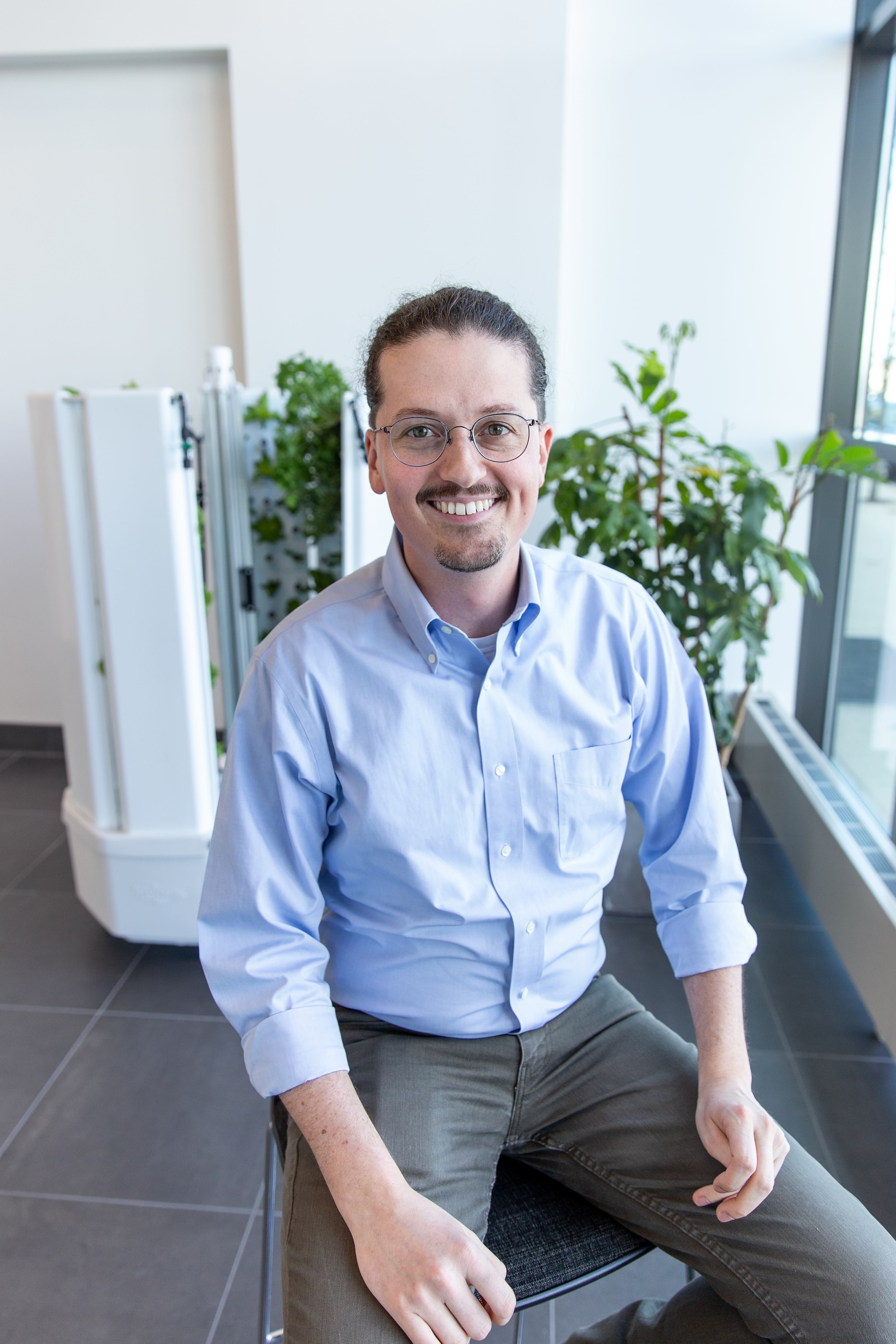
Founder & CEO, Fork Farms
Alex is the co-founder of Fork Farms and the inventor of its farming technology and methods. He is a former opera singer with 10 years of leadership experience in the social service sector, who works to inspire vast food system change across communities.
He began his urban agriculture career in Brooklyn, New York where he first worked on rooftop gardens and then started building indoor growing systems of his own for educational and food security purposes. This eventually led to the development of Fork Farms intellectual property, and the rest is history.
After relocating back to Wisconsin, Alex continued his work as program director at Goodwill Industries of North Central Wisconsin and as director of innovation and programs for Feeding America Eastern Wisconsin. In 2018, he was a Fox Cities Future 15 winner and featured as Fox Cities Magazine’s ‘Big Idea’.
Alex currently lives in Appleton, Wisconsin with his wife, son and their dog Maya.